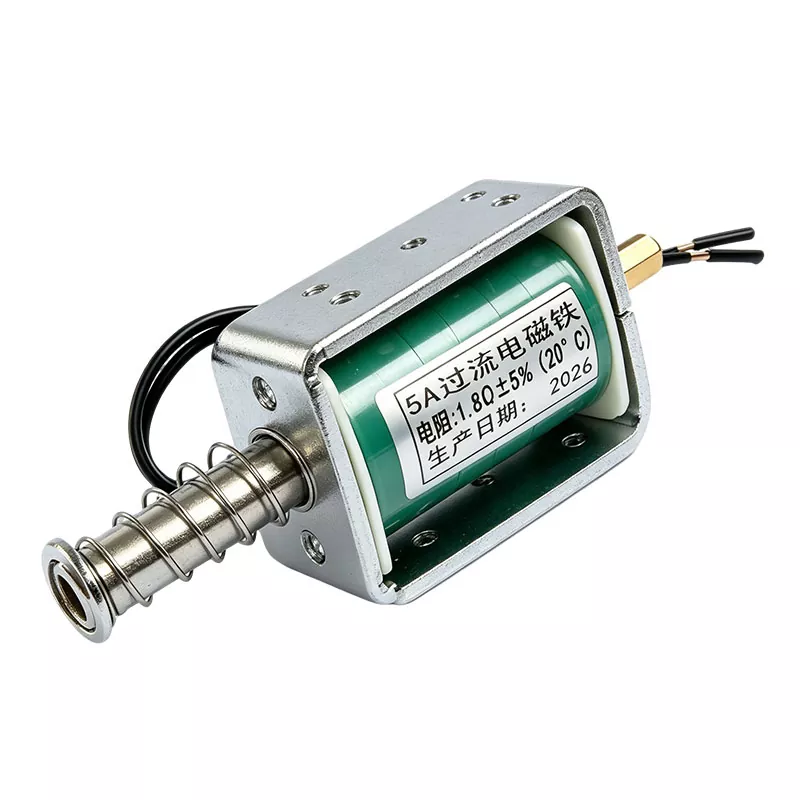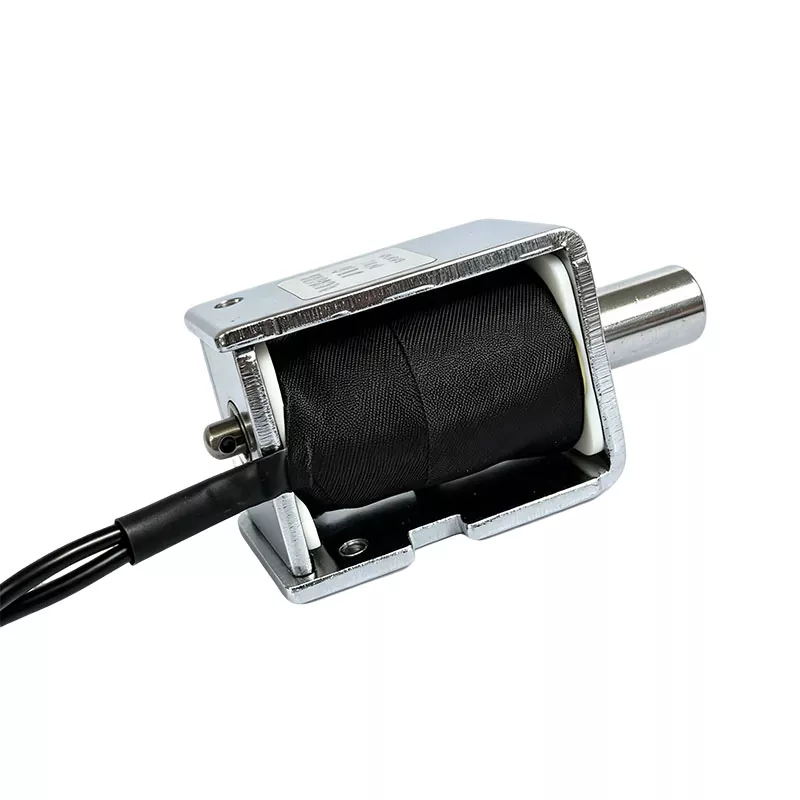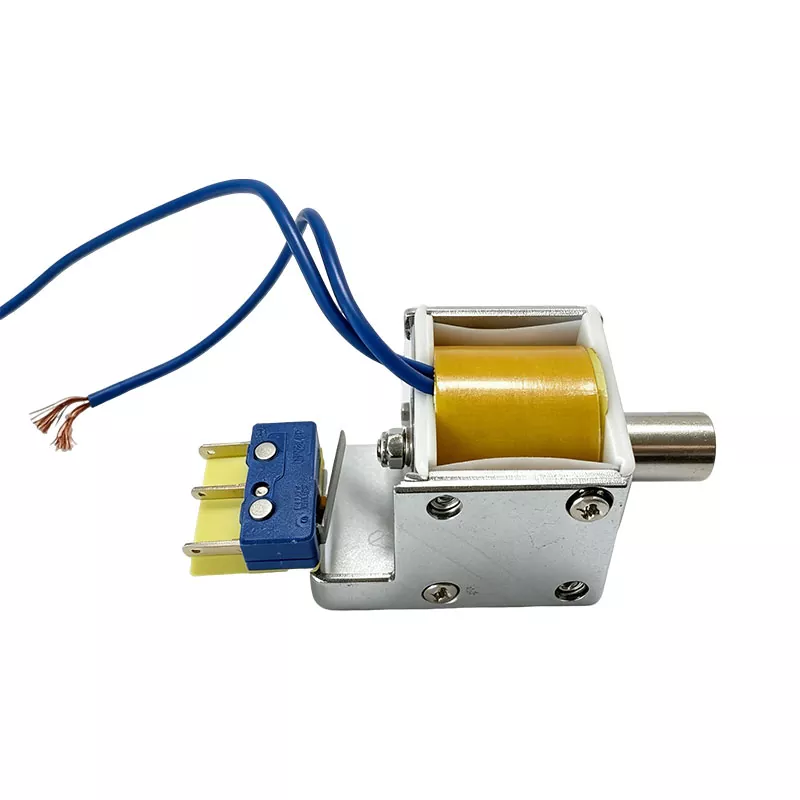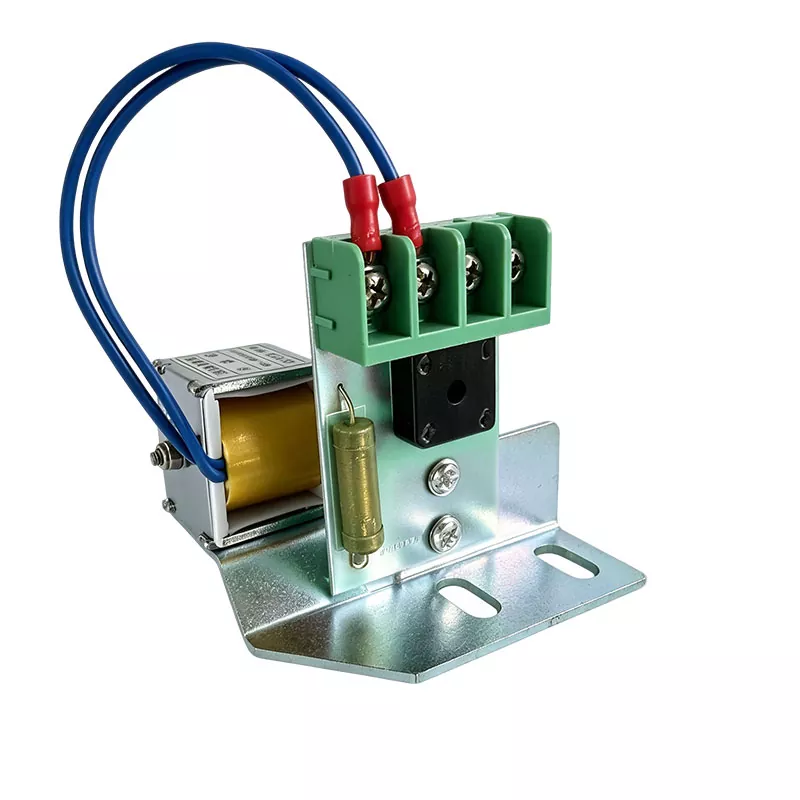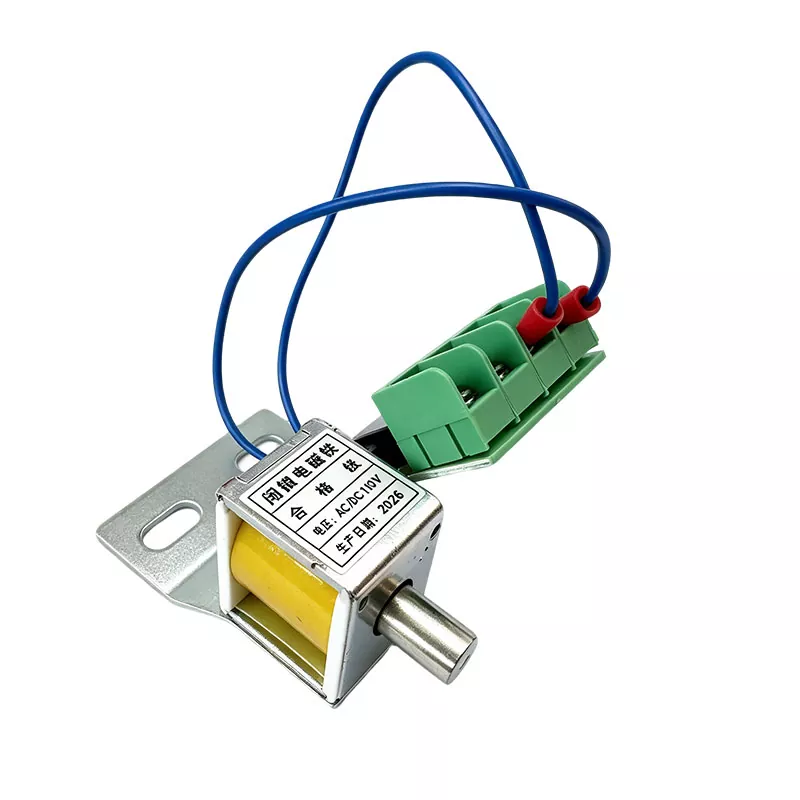
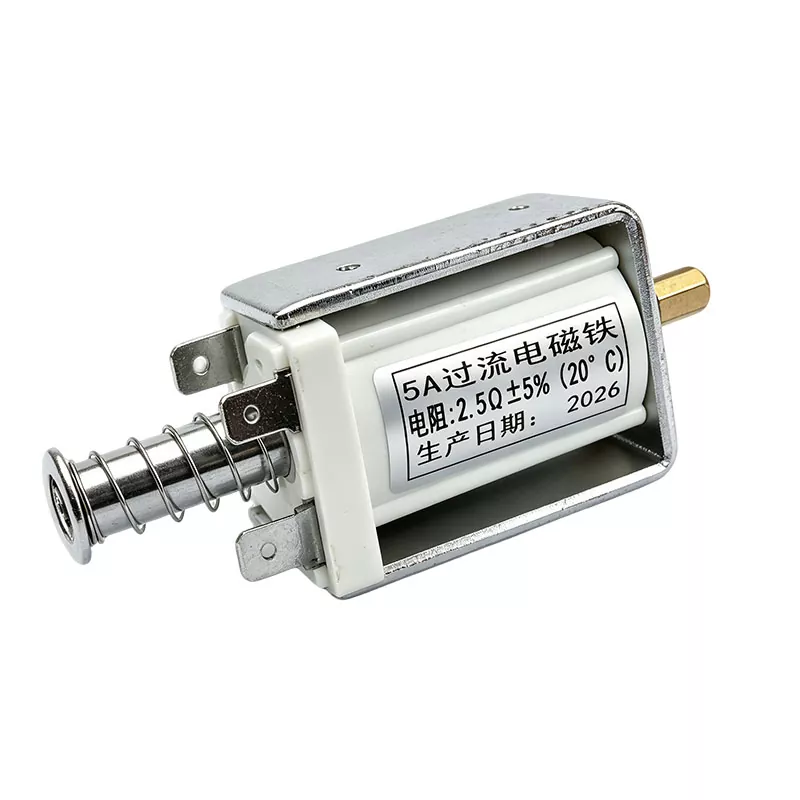
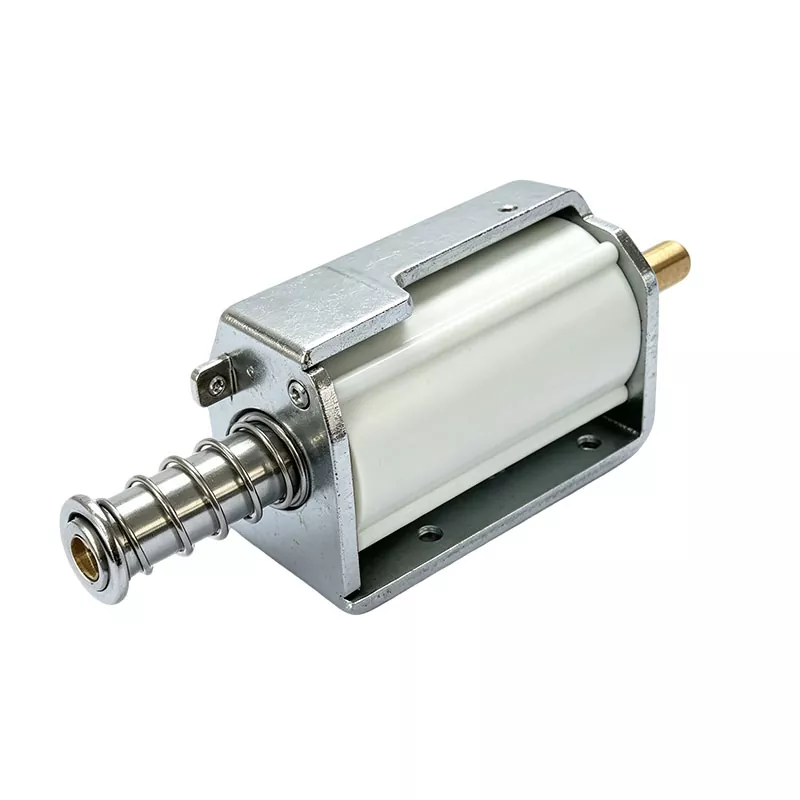
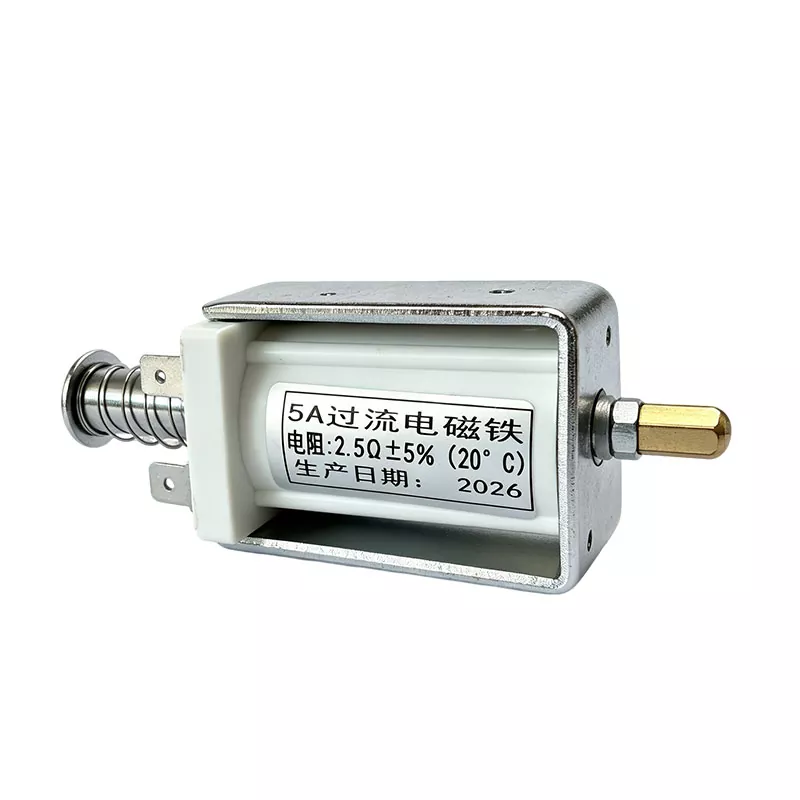
Dongfa Intelligent, a China manufacturer of the 5A Plug-in Terminal Overcurrent Solenoid, designs this component for circuit breaker overcurrent tripping mechanisms and switchgear overcurrent protection devices. It is a short-time duty solenoid rated at 5A driving current with a 2.5Ω ±5% coil at 20°C reference, two plug-in terminals, an external rear reset spring, a brass push rod, and a galvanized U-shaped bracket with three mounting holes. The product is intended for buyers who assemble tripping mechanisms and want faster wiring, simpler replacement, and individually verified operating current consistency across batches.
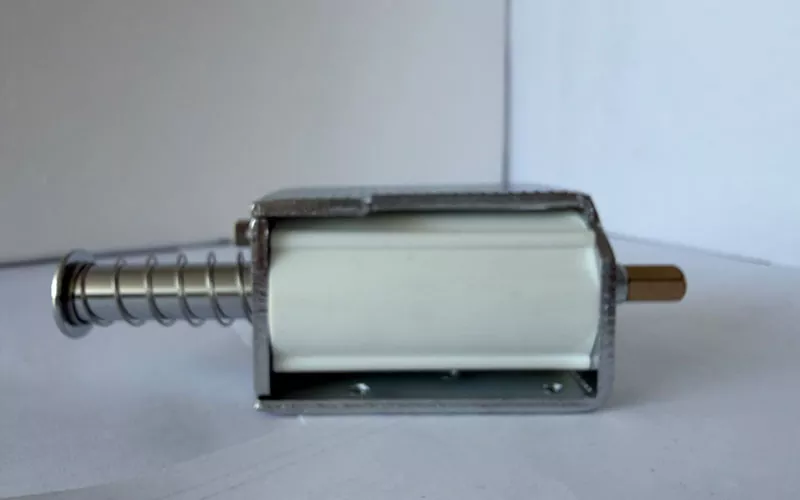
The wiring method of an overcurrent solenoid directly affects assembly labor and later maintenance cost. In this product, the coil leads terminate in two plug-in terminals rather than flying leads.
The 5A Plug-in Terminal Overcurrent Solenoid removes these steps by inserting directly into matching receptacles to complete the electrical connection, so no soldering or crimping is needed during assembly, and no rewiring is needed when the solenoid is replaced.
Plug-in terminals are not inherently less reliable than lead wires. This product uses standard plug-in terminals which, when matched with appropriate receptacles (female ends), provide low contact resistance and stable insertion force. In circuit breaker tripping mechanisms, an overcurrent solenoid typically actuates once during a fault, and the contact reliability of plug-in terminals under short-time high current has been verified. For applications involving frequent plugging or high vibration, adding anti-loosening clips or using locking receptacles is recommended.
The reset spring is mounted externally at the rear of the solenoid. During inspection, the spring state can be observed directly to judge fatigue or deformation, and replacing the spring does not require disassembling the solenoid body. For circuit breakers that must operate reliably over long periods, this visibility and ease of replacement are practical advantages for O&M personnel compared with internal spring structures, which are more compact but require disassembly for maintenance.
The push rod is made of brass. Brass is non-magnetic and does not interfere with the distribution of the solenoid magnetic field; it also has good corrosion resistance and does not rust during long-term operation inside switchgear. Its machinability supports dimensional accuracy and surface finish of the push rod. Compared with chrome-plated carbon steel push rods, brass offers advantages in corrosion resistance and machining precision, while hardness and wear resistance depend on appropriate surface treatment or lubrication.
The coil bobbin uses white flame-retardant plastic with a flame retardant grade meeting insulation material requirements inside switchgear. The bobbin supports the coil winding and provides insulation between the coil and the housing. The white appearance makes carbonization or contamination easier to spot, helping maintenance staff detect potential insulation issues in time.
The housing and U-shaped bracket are galvanized, providing rust and corrosion resistance in the humid or temperature-varying environments found inside switchgear. The bottom bracket has 3 three mounting holes, giving more stable fixation than conventional two-hole brackets and reducing loosening caused by vibration.
| Parameter | Specification |
| Product Name | 5A Plug-in Terminal Overcurrent Solenoid |
| Rated Driving Current | 5A |
| Coil Resistance | 2.5Ω |
| Resistance Accuracy | ±5% (20°C reference) |
| Accessories | Coil body, U-shaped metal mounting bracket, external reset spring, brass push rod, white flame-retardant coil bobbin, plug-in terminals |
| Mounting Standard | Fixed mounting (U-shaped metal bracket with mounting holes, bolt locking) GB (China Electrical Industry National Standard) |
| Materials | Hard magnetic enameled wire winding, flame-retardant plastic coil bobbin, galvanized metal housing and bracket, brass push rod, stainless steel reset spring |
| Push Rod Material | Brass |
| Reset Method | Spring self-reset (rear external reset spring) |
| Terminals | 2 pcs (plug-in terminals) |
| Mounting Holes | 3 pcs on bottom bracket |
| Duty Cycle | Short-time duty (actuates momentarily during fault) |
| Certification | ISO9001 Quality Management System |
| Applications | Power systems, circuit breaker manufacturing, switchgear overcurrent protection mechanisms |
| Use Cases | Circuit breaker overcurrent tripping mechanisms, switchgear overcurrent protection devices |
| Packaging | Carton packaging |
When specifying the 5A Plug-in Terminal Overcurrent Solenoid, confirm the following parameters against the tripping mechanism design.
Both are 5A overcurrent solenoids, and the main differences are resistance value and structure. The 2.5Ω version uses plug-in terminals and an external reset spring; the 2.3Ω version uses lead wires and an internal reset structure. Different resistance values produce slightly different voltage drop and power loss at the same current, so the choice should follow the circuit breaker tripping mechanism design requirements.
To confirm compatibility, provide the original overcurrent solenoid model, rated driving current, coil resistance, mounting dimensions, push rod stroke, and quantity. The Dongfa Intelligent technical team reviews these details before production to avoid mismatch.
Standard receptacles (female ends) with specifications matching the plug-in terminals are required. Locking receptacles are recommended to prevent loosening from vibration. Matching receptacle selection advice can be provided on request.
The core process of the plug-in terminal overcurrent solenoid lies in the crimping quality between plug-in terminals and coil leads, and in the consistency of operating current. Assembly takes place on dedicated low voltage lines, and each unit undergoes operating current testing and dielectric withstand testing before shipment. Plug-in terminal crimping strength and contact resistance are spot-checked per batch, operating current is individually verified to ensure 5A±5% consistency, and external spring preload is individually checked to ensure reliable reset.
For switchgear builders, this means high voltage and low voltage parts can be purchased from the same supplier, reducing coordination costs and improving matching consistency. Products have been exported to Southeast Asia and parts of Europe, adapting to different market standards and requirements. The company is certified to ISO 9001, ISO 14001, and ISO 45001, and supports factory audits. Standard products: 7-15 working days. Custom products: 15-30 working days. Standard products support a 1-unit trial order, and urgent orders can be prioritized.
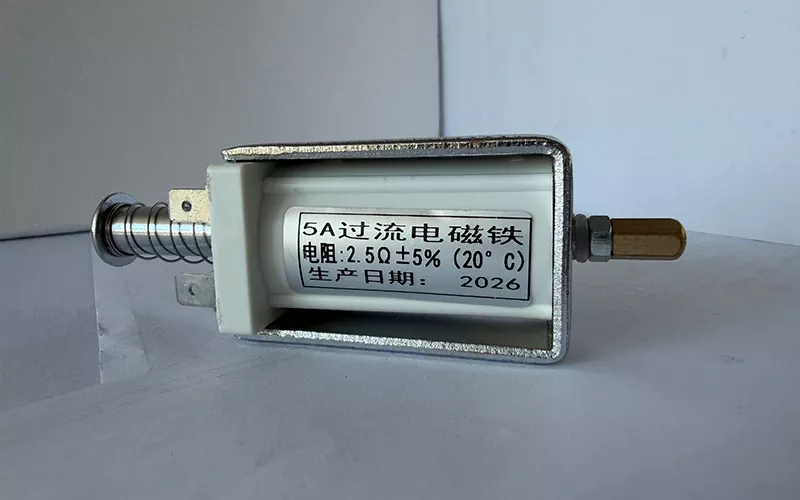
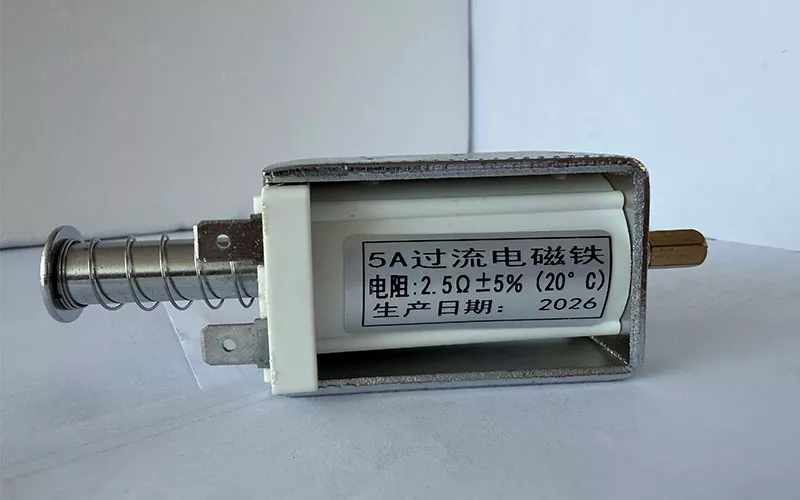
Plug-in terminals insert directly into receptacles to complete the electrical connection, eliminating soldering or crimping, which improves assembly efficiency and simplifies maintenance replacement. Ordinary lead wires require soldering or crimping, involve longer assembly labor, and require rewiring when the component is replaced.
Both are 5A overcurrent solenoids; the main differences are resistance value and structure. The 5A Plug-in Terminal Overcurrent Solenoid uses plug-in terminals and an external reset spring, while the 2.3Ω version uses lead wires and an internal reset structure. Different resistance values result in slightly different voltage drop and power loss at the same current, so selection should be based on the circuit breaker tripping mechanism design requirements.
An external spring allows direct status observation to judge fatigue or deformation, and replacing the spring does not require disassembling the solenoid body, making maintenance more convenient. Internal springs are more compact but require disassembly for maintenance.
The brass push rod is non-magnetic, corrosion-resistant, and has high machining precision, and it does not interfere with magnetic field distribution. A chrome-plated carbon steel push rod offers high hardness and wear resistance. Each has advantages, and the choice depends on the circuit breaker tripping mechanism requirements.
Standard receptacles (female ends) with specifications matching the plug-in terminals are required. Locking receptacles are recommended to prevent loosening from vibration, and matching receptacle selection advice is available.
Dongfa Intelligent is an own factory in Yueqing, Zhejiang, founded in 2012, with 14 years of manufacturing experience. Factory audits are supported, and visits are welcome.
Standard products support MOQ 1 unit. Standard lead time is 7-15 working days; custom products take 15-30 working days. Urgent orders can be prioritized.
Provide rated driving current, coil resistance, wiring method, mounting dimensions, and quantity. For replacement projects, the original model and mounting dimensions are recommended.
Address
No. 281, Wei 18th Road, Yueqing Economic Development Zone, Yueqing, Wenzhou, Zhejiang, China
Tel