MCCBs occupy the middle ground of low voltage protection — larger and more capable than miniature circuit breakers, smaller and more flexible than air circuit breakers. They protect distribution lines and motors against overload and short-circuit damage, and they are the workhorse device in building distribution, industrial control cabinets, motor circuits, and PV combiner boxes.
Dongfa Intelligent manufactures the GNM1 series in seven frame sizes — 63, 125, 250, 400, 630, 800, and 1250 — with thermal-magnetic trip units, 3-pole and 4-pole configurations, and both distribution and motor protection types.

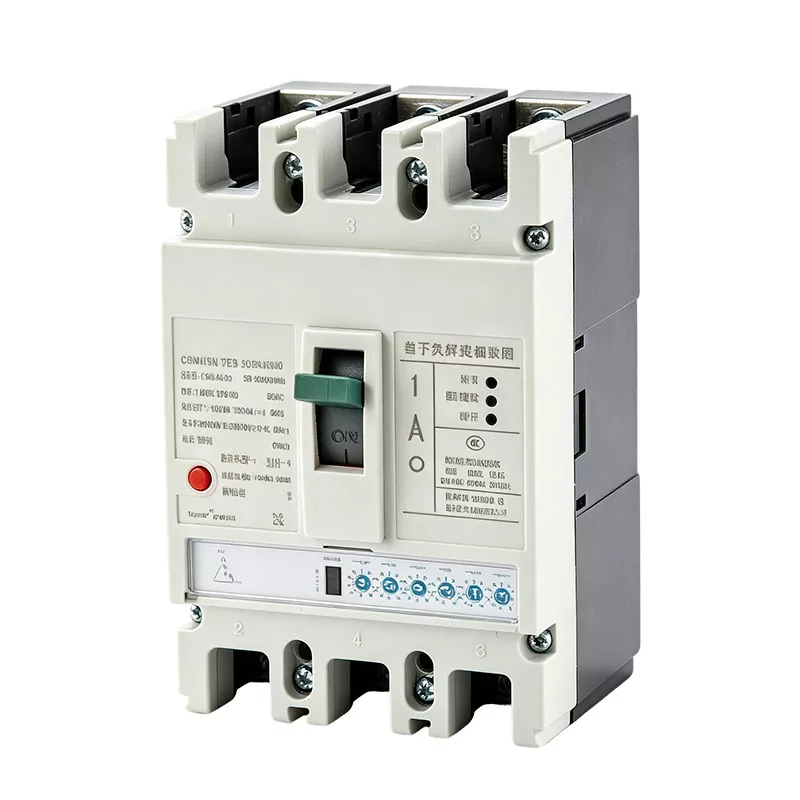
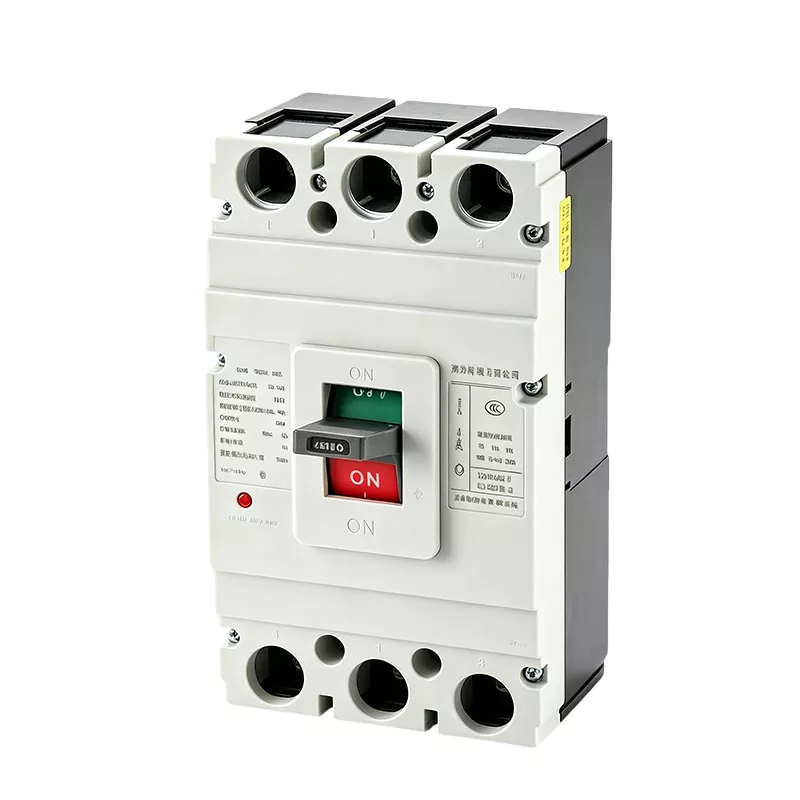
GNM1 Series MCCB

GNM1E Series MCCB
The frame size determines both the current range and the breaking capacity ceiling. Selecting the right frame is the first decision — everything else follows from it.
GNM1-63L
16–63A
GNM1-125M
16–125A
GNM1-250H
100–250A
GNM1-400H
225–400A
GNM1-630M
400–630A
GNM1-1250M
630–1250A
The trip unit is what makes an MCCB an MCCB. It contains two independent sensing elements, each responding to a different kind of fault.
A bimetal strip heats up as current flows through it. At normal current, the heat dissipates and the strip stays flat. Under sustained overload, the strip bends gradually until it trips the mechanism.
A solenoid coil generates an electromagnetic force proportional to current. Under short-circuit, the force becomes strong enough to trip the mechanism instantly — no heating delay.
An MCCB's rated current assumes a reference ambient temperature. In real installations — especially in tropical climates or enclosed cabinets — the actual current-carrying capacity is lower. Ignoring this is one of the most common causes of nuisance tripping and premature aging.
Altitude also matters. Above 2000m, both the continuous working current and the breaking capacity require correction — thinner air reduces both cooling efficiency and insulation withstand.
Thermal-magnetic trip units individually verified for operating characteristics, ensuring reliable overload and short-circuit protection.
Six frame sizes covering the full range, so the protection level matches the actual prospective short-circuit current at the installation point.
Published correction factors for high-temperature and high-altitude environments — not left to guesswork during selection.
Both pole configurations available across the range, plus a dedicated motor protection trip type for direct motor circuit use.
The GNM1E series adds an electronic trip unit with adjustable setting current range of 0.4–1.0In — configurable long-time, short-time, and instantaneous protection.
Better price at equivalent IEC configuration. Standard lead time 7–15 days, with MOQ as low as 1 unit for sample and trial orders.
Zhejiang Dongfa Intelligent Electric Technology Co., Ltd. was founded in 2012 in Yueqing Economic Development Zone, Wenzhou, Zhejiang. Factory area over 2,000㎡, 17 employees, 4 technical engineers, 2 production lines, 1 set of testing equipment. Monthly capacity 600–700 units, annual capacity 7,000–8,000 units. Products exported to Southeast Asia and parts of Europe.
MCCBs are assembled on dedicated low voltage lines. Each unit undergoes mechanical operation testing, trip characteristic testing, and dielectric withstand testing before shipment. Thermal-magnetic trip units are individually verified for operating characteristics, ensuring reliable overload and short-circuit protection. Certified to ISO 9001, ISO 14001, and ISO 45001, with factory audits supported.
“We purchased Dongfa Intelligent's GNM1 series MCCBs for an industrial park distribution project in Vietnam. The 250A frame was used at a derating factor of 0.91 under +50°C, and it has operated for two years without nuisance tripping. Their technical team helped us confirm the derating calculation during selection.” — Procurement Manager, Southeast Asian Power Engineering Company
Practical questions buyers ask when selecting molded case circuit breakers for distribution and motor protection projects.
Choose thermal-magnetic when the load is simple and the protection curve does not need adjustment — distribution circuits, standard motor circuits, and applications where the breaker is set once and left alone. Choose electronic trip when you need an adjustable setting current range (our GNM1E covers 0.4–1.0In), configurable long-time / short-time / instantaneous protection, or communication capability for remote monitoring. Electronic trip units also handle wide current ranges better, reducing the number of SKUs a panel builder needs to stock.
Because the rated current is defined at a reference ambient temperature — typically 40°C. Above that, the bimetal strip inside the thermal element sits closer to its trip threshold even at normal current, so it takes less overload to trip it, and it may nuisance-trip on a healthy circuit. At 50°C the factor is 0.91, at 60°C it drops to 0.82. If your calculated load is 220A and you select a 250A frame, at 50°C the effective capacity is only 228A — a narrow margin that leaves no room for transient peaks or future load growth.
Icu (ultimate short-circuit breaking capacity) is the maximum fault current the breaker can interrupt without failing catastrophically — but after a fault at this level, the breaker may not be reusable. Ics (service short-circuit breaking capacity) is the fault current the breaker can interrupt and then continue to operate normally. Ics is always lower than Icu, and the ratio between them tells you how robust the breaker is. A high Ics/Icu ratio (for example, 65kA Ics against 85kA Icu on the GNM1-250H) means the breaker can clear a severe fault and still be put back into service.
Choose the motor protection type when the MCCB feeds a motor directly, without a separate overload relay. The motor protection trip unit has a magnetic trip threshold set higher — typically 12–14In instead of the standard 10In — so it does not trip on the motor's normal starting inrush, which can reach 6–8 times rated current for several seconds. The distribution type would see that inrush as a short circuit and trip. If you already have a separate thermal overload relay in the motor circuit, the standard distribution type is sufficient.
At high altitude, the air is thinner, which affects the breaker in two ways. First, cooling is less effective — the bimetal strip and current-carrying parts run hotter for the same current, so the working current must be reduced. Second, insulation withstand is lower — the reduced air density makes it easier for an arc to form across the contact gap, so the breaking capacity must also be corrected. IEC 60947-2 provides correction factors for altitudes above 2000m. Both corrections are required, not just one.
Yes. MOQ is 1 unit, and standard lead time is 7–15 working days. This allows buyers to verify the trip characteristics, mounting dimensions, and terminal arrangement on a real unit before placing a production order. Custom configurations — special trip curves, non-standard terminal types, or specific nameplate requirements — are also available on request, with lead time confirmed at the time of order.
Please provide: Frame Size + Rated Current + Breaking Capacity Requirements + Poles + Trip Type + Quantity. Send an inquiry, and our technical team will provide selection advice and a quote within 24 hours.
Send Requirements